
Team

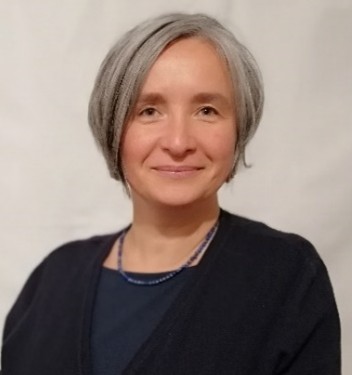
Prof. Mihaela Georgeta Moisescu, PhD
Project Director / Medical Doctor
Prof. Dr. hab.Mihaela G. Moisescu is a medical doctor and professor of Biophysics at Carol Davila University of Medicine and Pharmacy in Bucharest. She is the head of the Biophysics and Cellular Biotechnology Dept. coordinating both research and teaching activities, including the Master Program in Medical Biophysics and Cellular Biotechnology running at the Faculty of Medicine. Her research focuses on the interaction of electric fields with living cells (electroporation, dielectrophoresis) and cellular biology (endocytosis, membrane processes, cellular energetics). She was part of the team who implemented the first electrochemotherapy treatment in Romania on a melanoma patient. She has long experience in coordinating national and international research grants, and she is co-inventor of a granted patent (OSIM 134410) on classifying tissue malignancy using digital holographic microscopy (DHM). Together with her colleagues, she demonstrated that DHM represents a useful tool for monitoring fast/slow cellular processes such as transmembrane water movement, variations of cell height/dry mass index during electroporation due to membrane electropermeabilization and modification of refractive index in malignant cells.
Violeta Liuba Călin, PhD
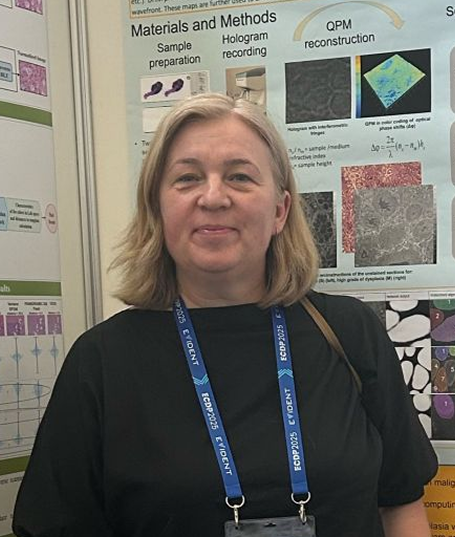
Post-doc / Physicist
Dr. Violeta Calin is a physicist with expertise in biophysics and digital holographic microscopy. She has led pioneering work on holographic biomarkers (such as refractive index, dry mass density, and bimodality coefficient) to evaluate the metastatic potential of living cells. Violeta developed and validated protocols for preparing unstained histologic slides suitable for DHM across multiple tissue types, including breast, cerebral tumors, and colonic adenomas. Her research has demonstrated the use of holographic imaging in tumor grading, notably identifying biomarkers for glioma classification. She is co-inventor of a granted patent (OSIM 134410) on procedures for classifying unstained biopsies using holographic biomarkers. VLC has advanced expertise in characterizing living cells by optical biomarkers extracted by image processing; she is a MATLAB / Cell Profiler / Fiji proficient user. She constantly contributed to the implementation of machine learning and neural network models in cellular/tissue imaging.
Ioan Cristian Tivig, PhD
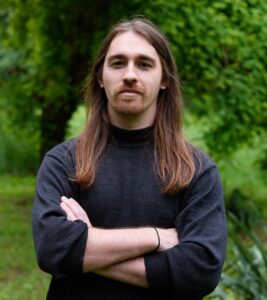
Post-doc / Biologist – Programmer
Curious about the intersection of technology and biology, Dr. Ioan Tivig has worked across biochemistry, biophysics, biotechnology, and bio-microfabrication. His main research focuses on electric field applications, such as dielectrophoresis and electroporation, as well as optical trapping with optical tweezers. He also brings strong skills in programming (Python, C++), 3D printing (FDM and resin), and modeling/simulations (CAD software and COMSOL) of electric fields. He is the main developer of the OpenDEP Dielectrophoresis Platform and the Holopath DHM Image Processing Platform. He constantly contributed to the development of microfluidic-integrating platforms to characterize and separate cells and to prototyping different models of electroporation / dielectrophoresis electrodes/chambers.
Prof. Tudor Savopol, PhD
Senior Researcher / Chemist
Prof. Dr. hab. Tudor Savopol co-authored the first report of the 3D structure of sensory transducer rhodopsin II complex (Nature, 419 (6906), 2002) and has high expertise in developing and optimization of optic and electric techniques such as optical tweezers – dielectrophoretic cell trap for cell biology applications, spectroscopic techniques applied to lipid bilayers and cellular membranes and microscopy (transmission, fluorescence).
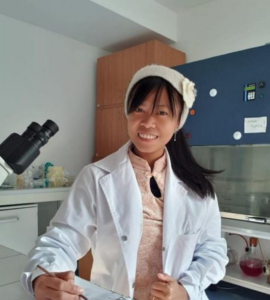
Christien Oktaviani Matei, PhD student
Assistant Researcher / Medical Doctor
Christien Oktaviani Matei is a medical doctor and young researcher interested in developing interdisciplinary collaborations integrating medical biophysics, cellular biology, and oncology. With expertise in platelet biology, 2D/3D cell culture models, and fluorescence assays, her research explores electrochemotherapy, resting membrane potential, membrane fluidity, ROS dynamics, and cell viability in cancer and related pathological conditions.
Florela Gherghinoiu, PhD student
Assistant Researcher / Biotechnology engineer
Florela Gherghinoiu is a PhD student with expertise in biotechnologies and cellular viability assays. Her doctoral research focuses on the biophysical characterization of cells using electric field-based techniques (dielectrophoresis, electroporation) and combined technologies like electro-optical traps based on optical tweezers.
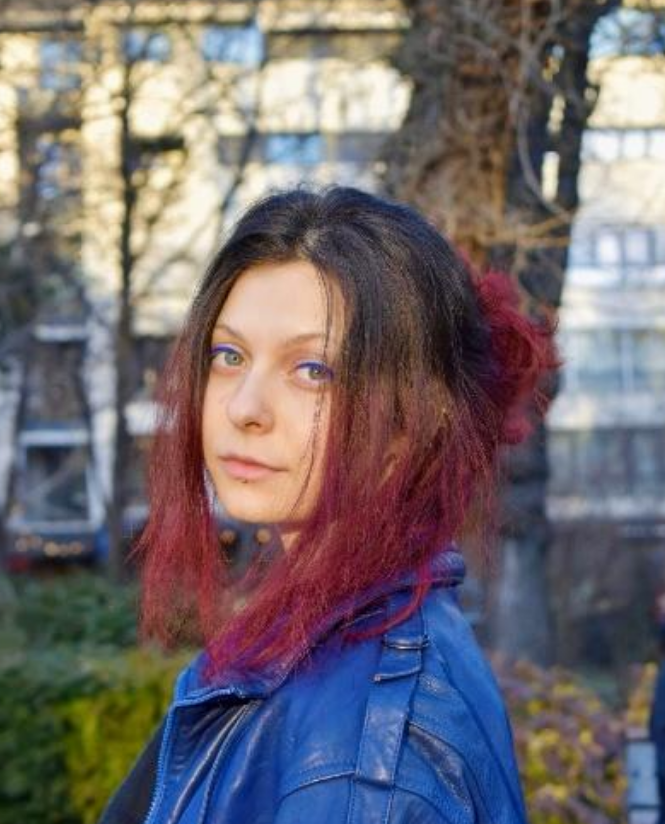

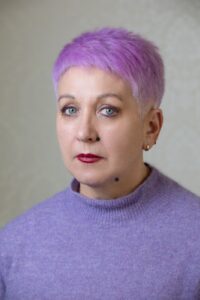
Assoc. Prof. Elena Achimova, PhD
P1 Responsible / Engineer
Assoc. Prof. Dr. hab. Elena Achimova is the head of Recording Media and Photonics Group at the Materials for Photovoltaic and Photonics Laboratory, Institute of Applied Physics, Moldova State University. Her scientific topics of interest are: non-crystalline physics, diffraction optics and optical sensors, holography and holographic interferometry. Prof. Achimova applied laser interferometry techniques for measuring displacements, stress and strain, velocities, vibrations, slopes and curvatures of optically rough surfaces. She contributed to the development of: i/ Digital Holographic Microscope (DHM) set-ups, ii/ portable Electronic Speckle Pattern Interferometers with optical fibers for full field investigation of defects and vibrations of carbon glass composite panels samples, defected wood and icons, human dents, and iii/ vibration sensors (stethoscopes) for medical diagnostics with data analyses in frequency domain and determination of critical situations. Recently, she contributed to the development of a phase-sensitive DHM which has been tested on cancer cells, pollen particles and heart tissue. Prof. Achimova is co-author of 5 patents.
Veronica Cazac, PhD
Post-doc / Physicist
Dr. Veronica Cazac is a research scientist specializing in digital holographic microscopy for investigation of different transparent probes used in biomedical applications or material sciences, and her work focuses on physics, technology, and development of photonic devices. She specializes in the analysis of digital holograms and image-quality enhancement, having developed MATLAB algorithms and software for advanced holographic image reconstruction. Veronica also contributed to the implementation of software solutions for phase-sensitive DHM. Veronica coordinates national research projects for early-stage researchers.
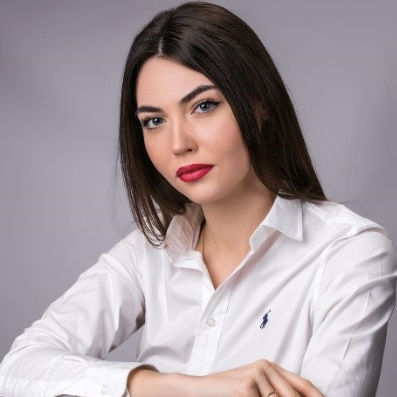
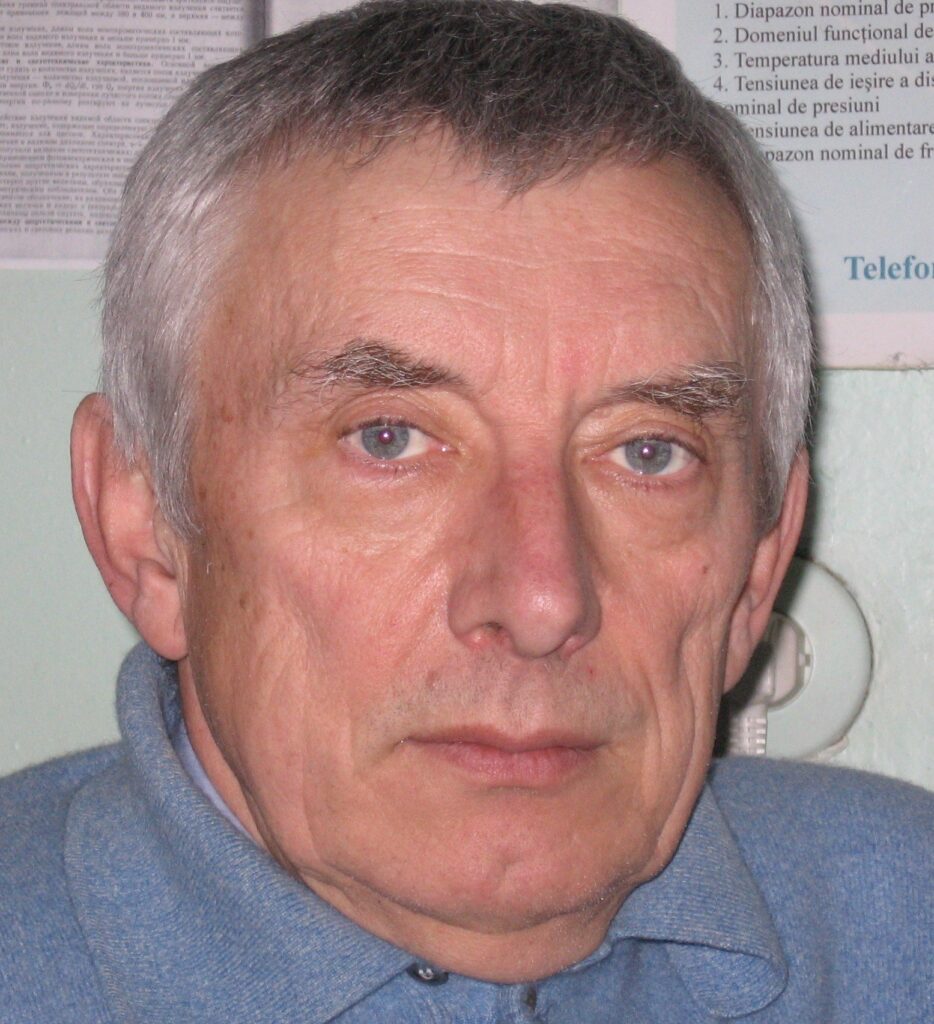
Vladimir Abașkin, PhD
Engineer
Dr. Vladimir Abașkin is a senior researcher who co-author 11 patents in the field of biophotonics and material sciences. His long expertise in physics and engineering of non-crystalline materials and structures, holography, photonic and optoelectronic devices, including creating diffraction-enhanced structures. Present experimental interests are the design and application of interferometers based on optical fibers and different types of lasers and LED’s. He applies the modern research methods including Vision systems, LabView, and ZEMAX. Dr Abașkin obtained special results in holographic speckle-interferometry and phase analysis of optical images.
Constantin Loșmanschii, PhD student
Researcher / Chemist
Constantin Loșmanschii is specializing in the synthesis of polymers, copolymers, and azopolymers for optoelectronic and photonic applications. His PhD thesis focuses on photosensitive azopolymers containing nanoparticles for polarization-sensitive diffractive optical elements. He also develops software and automation systems for optical experiments, including laser polarization control with liquid-crystal devices.

Vladislav Botnari, PhD student
Researcher / Chemist
Vladislav Botnari studies spectral, optical, and structural properties of thin films using advanced imaging techniques such as DHM, AFM, and SEM. His research work focuses on the synthesis of polymers, copolymers, and azopolymers for photonic applications and on holographic recording of diffractive optical elements. His PhD thesis addresses the synthesis, characterization, and implementation of azopolymer-based nanocomposites.